
When most people hear the word balance, they immediately think of standing on one leg. Tree pose. Warrior 3. Half Moon. That moment where everything goes quiet and you try not to fall over.
But if I’m honest, holding the pose isn’t usually the hardest part. It’s getting there.
The step forward. The shift of weight. The moment your back foot leaves the floor. That’s where things start to wobble. You might feel perfectly steady once you’ve arranged yourself in the shape. But stepping into it? That can feel rushed, shaky, or slightly chaotic. And that’s exactly why this month isn’t about holding balance poses for longer.
It’s about how we move into them.
Because real balance isn’t about being still. It’s about staying organised while things are changing. And that’s much closer to real life, isn’t it? We rarely stand still in life. We move between things. Between tasks. Between moods. Between stages. Between feeling certain and feeling unsure. Transitions are where we feel it most.
On the mat, that might look like wobbling when stepping back into Warrior 3. Off the mat, it might look like feeling unsettled when something shifts and you’re not quite ready. The body doesn’t separate these experiences as neatly as we think.
So this month, we slow down the in-between moments.
Instead of rushing from lunge to balance, we’ll pause before the step. Feel the weight shift. Notice the standing foot. Engage the hip before asking it to stabilise everything. It might not look dramatic. But it changes everything.
One of the biggest surprises for people is that balance issues are rarely about focus alone. Of course attention helps, but most of the time the wobble has a physical reason. Often it’s the outer hip of the standing leg. That muscle has to keep the pelvis level. If it’s not strong enough, the hip drops slightly and the ankle starts overworking to compensate. The foot grips. The shoulders tense. The breath shortens. Suddenly balance feels like effort. Then there’s the ankle itself. Your ankle is constantly making tiny adjustments to keep you upright. If it’s stiff or underused, those small adjustments become bigger wobbles. And then there’s speed. We move quickly. We swing the leg up. We throw ourselves into the pose and hope for the best. And then we wonder why it feels unstable.
So this month we practise moving slowly on purpose. You’ll notice repetition in the classes. We’ll move from lunge to balance, back to lunge, again and again. We’ll step forward with control instead of momentum. We’ll focus on how the foot leaves the floor, not just where it lands. Repetition can feel simple. But simple is powerful. The nervous system loves repetition. It builds familiarity. And familiarity builds confidence.
Something else happens when you slow transitions down. You begin to notice where you’re gripping unnecessarily. Are your shoulders creeping up? Are you holding your breath? Are you clenching your jaw? A rigid body doesn’t balance well.
Balance becomes steadier when you stop trying to force it. And here’s the part I really like about this theme. It makes your practice feel more intelligent. Less about achieving the final shape and more about understanding how you move. It also makes balance more accessible. If you’ve ever thought, “Balance just isn’t for me,” I really encourage you to approach it differently this month. We’re not jumping into complicated shapes straight away. We’re building from the ground up. Ankles, hips, core support and slow weight shifts. The way you exit a pose tells you as much as the way you enter it. And maybe this is the bigger picture.
Transitions are uncomfortable because they’re uncertain. You’re not fully here, and you’re not fully there. On the mat, that’s the split second where your weight shifts and you’re not sure if you’ll stay upright. In life, it’s the phase where things are changing and you don’t quite feel settled. The skill is the same in both places. Stay present. Adjust. Breathe.
Wobbling isn’t failure. It’s information. It tells you where to build strength. Where to slow down. Where to soften.
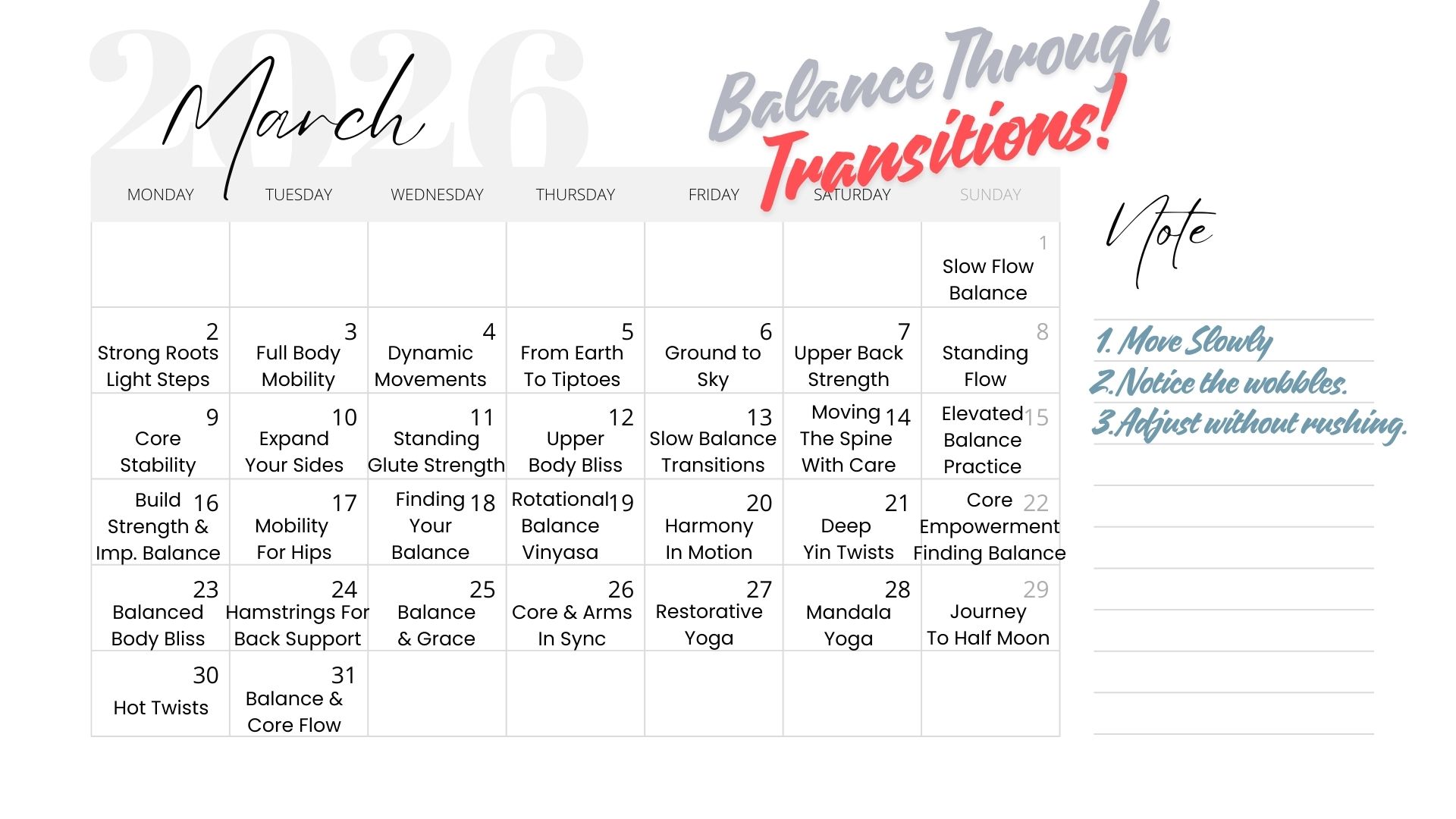
Inside this month’s calendar, you’ll find slow, repetitive balance flows designed to build confidence through consistency. There are sessions that focus on hip stability, others that work on ankle strength and control, and some that combine twists with balance so you can practise staying steady even when the body rotates. Everything connects.
You don’t need to plan it. Just follow the calendar and let it build gradually. And remember, this doesn’t have to be intense to be effective. Even practising once a week, really paying attention to how you step, how you shift, how you organise yourself before lifting a foot, will start to change how balance feels.
By the end of the month, I don’t want you to simply hold Half Moon for longer. I want you to feel calmer stepping into it. I want you to trust the standing leg more. I want you to notice the foot pressing evenly into the floor. Balance isn’t something you either have or don’t have. It’s something you train patiently.
And the beautiful part is that when transitions feel steadier on the mat, something shifts off the mat too. You begin to trust yourself more in moments of change.
If you’re already a member, open the March calendar and start with Day 1. Move slowly. Notice where things feel uncertain and treat that as useful information, not criticism.
If you’re not yet a member, this is a lovely month to join. You can begin with a 5-day free trial and explore the theme without pressure. Let your body decide if it feels supportive. https://www.aysegulyoga.com/on-demand-yoga/
This month, we’re not chasing perfect balance. We’re practising how to move through change without losing our centre. And that’s a skill worth building. 🧘🏻♀️
All the best,
Ayse x